Many areas in the country are experiencing poor air quality due to smoke from Canadian wildfires. Canadian wildfire smoke has intermittently affected United States air quality for many years but beginning in 2023, the impacts became unprecedented in scale. The U.S. has been impacted by significant cross-border smoke events affecting the Midwest, Great Lakes, Northeast, and other eastern areas in 2023, 2024, 2025, and 2026. This pattern has made smoke planning relevant for employers even though they are far from the fire line. Smoke travels hundreds or even thousands of miles, affecting print shops, loading docks, delivery routes, outdoor sign installations, and vehicle-wrap work. For printing industry employers, the goal is to keep production moving while protecting employees when the air becomes unhealthy.
What Is Wildfire Smoke?
Wildfire smoke is a changing mixture of gases, vapors, and particles produced when vegetation, buildings, vehicles, plastics, treated wood, and other materials burn. The most important health concern for most workers is fine particulate matter, known as PM2.5. These particles are 2.5 micrometers or smaller, small enough to reach deep into the lungs and, in some cases, enter the bloodstream.
Smoke may also contain carbon monoxide, carbon dioxide, volatile organic compounds, hydrocarbons, nitrogen oxides, benzene, acrolein, aldehydes, polycyclic aromatic hydrocarbons, and metals. The mix depends on what is burning, how hot the fire is, wind patterns, and whether the fire reaches developed areas. Smoke from a wildland-urban interface fire may be more complex because it can include combustion products from structures, vehicles, signage materials, fuels, and synthetic products.
When Is the Air Unhealthy?
The easiest way to judge risk is to check the Air Quality Index (AQI) for PM2.5 using AirNow, a state air agency, or a reliable local monitor. AQI is color-coded and designed to help people decide when to reduce exposure.
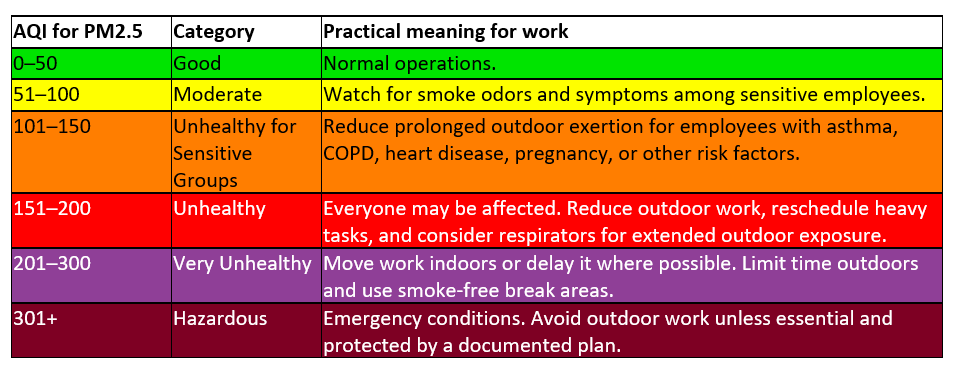
On a typical day, the AQI for a region may be green or yellow. When smoke is present and the air is hazy, the orange zone is most likely. Recently in July,2026 the wildfire smoke caused the AQI in cities to reach the Hazardous red zone. In Chicago, the AQI was more than 700, which is double the Hazardous threshold. Depending on the AQI level, printing companies may need to take action to mitigate workers’ exposure to outside air.
Why This Matters in Printing
Printing companies may have a mix of indoor, vehicle-based, and outdoor work. Shop employees may be protected if the building has effective mechanical ventilation, and doors remain closed. However, delivery drivers, warehouse staff moving freight, sign installers, survey crews, and vehicle-wrap teams can have repeated outdoor exposures during loading, unloading, measuring, ladder work, surface preparation, and installation. Drivers may also lose protection if windows are open, cabin filters are poorly maintained, or doors are opened frequently throughout the route.
How to Protect Workers
The best protection strategy is to combine planning, air-quality monitoring, engineering controls, work-practice changes, and respiratory protection when conditions warrant. The following actions can help reduce the impact of wildfire smoke exposure:
- Check AQI before and during the shift. Assign someone to monitor PM2.5 conditions for the shop, delivery routes, and installation sites. Wildfire smoke conditions can change quickly.
- Move or reschedule work. Shift outdoor installs, fleet wraps, surveying, and heavy loading to cleaner-air periods when feasible.
- Create cleaner-air spaces. Keep doors, windows, and dock openings closed as much as possible. Use well-maintained HVAC filtration and provide indoor or filtered break areas.
- Reduce exertion. Slow the pace of outdoor work, rotate tasks, add breaks, and avoid strenuous ladder, lifting, or installation work during high-smoke periods.
- Use vehicle controls. Keep windows closed, use recirculation when appropriate, maintain cabin air filters, and minimize unnecessary idling or open-door time.
- Provide respiratory protection when needed. National Institute for Occupational Safety and Health (NIOSH) approved respirators, such as N95 or P100 models, can significantly reduce exposure to fine particulate matter (PM2.5) when properly fitted and worn. Surgical masks, cloth face coverings, and poorly fitting respirators do not provide reliable protection against wildfire smoke. Employees should receive training on the correct use, limitations, and maintenance of respirators. When respirator use is mandatory, employers must comply with OSHA respiratory protection requirements, including implementing a written respiratory protection program. If respirators are offered for voluntary use, employers must provide workers with the information contained in Appendix D of OSHA's Respiratory Protection Standard, unless more stringent requirements apply under an OSHA-approved state plan.
- Train employees. Explain symptoms such as coughing, wheezing, eye irritation, chest tightness, shortness of breath, dizziness, or worsening asthma. Encourage employees to report symptoms early and seek medical attention without retaliation.
- Plan for sensitive workers. Employees with asthma, COPD, heart disease, pregnancy, or other medical concerns may need accommodation quickly, such as indoor assignments or schedule changes.
Current State Law Summary
OSHA does not have a safety standard written specifically for wildfire smoke. However, federal OSHA can still address serious smoke-related hazards through the General Duty Clause, which requires employers to provide a workplace free from recognized serious hazards when feasible controls exist. Several states have adopted their own specific wildfire smoke standards:
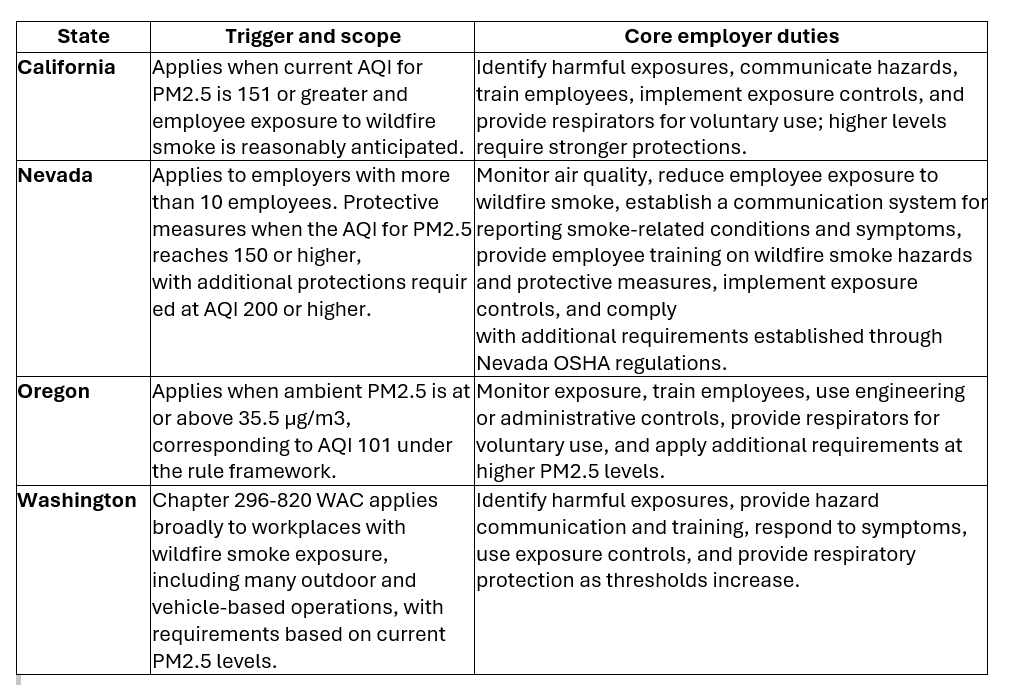
Although other states do not have wildfire-smoke-specific workplace standards, employers should still monitor AQI, document decisions, use feasible controls, and follow federal OSHA, NIOSH, EPA, and state public-health guidance.
Conclusion
A practical wildfire-smoke plan does not need to be complicated but does require preparation. Before wildfire smoke season, identify outdoor and vehicle-based tasks, decide who checks AQI, maintain HVAC and vehicle filters, stock appropriate respirators, train employees, and set decision points for delaying or modifying work. During a smoke event, make decisions based on PM2.5 levels and not just smell or visibility. Communicate changes clearly to delivery drivers, installers, supervisors, customer service, and customers waiting for installation during smoke events.
In this article, Gary Jones, VP EHS Affairs, PRINTING United Alliance, addresses protecting workers from wildfire smoke. Reach out to Gary should you have additional questions specific to how these issues may affect your business: gjones@printing.org.
To become a member of PRINTING United Alliance and learn more about how our subject matter experts can assist your company with services and resources such as those mentioned in this article, please contact the Alliance membership team: 888-385-3588 / membership@printing.org.